You lift all of your weight
You cannot make the load lighter the way you can with dumbbells. If you weigh 70 kg, every rep lifts 70 kg.
For many people the pull-up is the exercise they cannot do even once. You can still learn it the same way as any other movement: with easier versions, a regular program and tests that show where you are. This guide explains why pull-ups are hard, what counts as a full rep, how negatives and dead hangs help and what a program looks like week by week. At the end you will see how the MISSION: Unbreakable app takes you from your first pull-up to 25, and how dips are learned the same way.
If you cannot do a pull-up yet, start with negative pull-ups: step up so that your chin is over the bar and lower yourself slowly, over 3 to 5 seconds, to straight arms. Train 2 to 3 times a week with a rest day in between. Do five sets per session and rest one to two minutes between sets. Every couple of weeks, test how many full pull-ups you can do in one go. A full pull-up starts from a hang with straight arms, brings your chin over the bar and ends with straight arms again. Once the first one works, keep the same structure with full pull-ups and add one rep at a time.

In a pull-up you lift your whole body with your arms. In a push-up your feet carry part of the weight; in a pull-up they do not.
You cannot make the load lighter the way you can with dumbbells. If you weigh 70 kg, every rep lifts 70 kg.
In a US study, the women who learned to do a pull-up during a training period were stronger relative to their body weight than those who did not (Flanagan et al. 2003).
The biceps, the forearm muscles and the chest muscle were more active when pulling up than when lowering down (Dickie et al. 2017). That is why the lowering often works before the pull.
Many people have not hung from a bar since childhood. The grip tires and the shoulders feel strange even when the biceps could go on. Dead hangs get you used to both.
Before your first full pull-up, your rep count shows no progress because it is zero. Keep separate results for the easier versions instead: the number of negatives and the length of your dead hang show that you are moving forward.
A full rep is easy to define. The same definition is used, for example, in the US Marine Corps fitness test.
You can choose your grip. With an overhand grip your palms face away from you, with an underhand grip towards you; the underhand version is often called a chin-up. In measurements, muscle activation over the full rep was almost the same across grips (Dickie et al. 2017), so choose the grip that feels good in your shoulders. Keep it the same in tests so that your results can be compared.
Partial reps can be useful as exercises, but they do not count as results. When you only count full reps, your test results can be compared week to week, and you know exactly when your first pull-up has happened.
The test shows where you start. Do it rested, not after a hard workout.
Misty Posey, who created a pull-up program for the US Marine Corps, built the training on four exercises: assisted, negative and jumping pull-ups and pull-ups with a shorter range of motion (DVIDS 2016).
Step up or jump so that your chin is over the bar, then lower yourself slowly, over 3 to 5 seconds, to straight arms. Count the seconds in your head. When the lowering speeds up, the set is done.
Hang with straight arms for as long as your grip holds well. It gets your grip and shoulders used to the bar, and it is the starting position of every full pull-up. It does not train the pull, so do it alongside negatives.
Stand on a step under the bar, jump and pull at the same time until your chin is over the bar, then lower yourself under control. Your legs do part of the work, so you practice the top of the pull.
A partner supports you, for example by the ankles, and helps just enough for you to get up. The help is reduced as you get stronger.
A pull-up over part of the range, for example from the top to halfway and back. It builds strength, but it does not count as a full rep.
They make the whole movement lighter, and the help is easy to adjust. Posey, however, advises that they do not train the pull-up movement as well as bodyweight exercises, so they should not be your only tool.
Easier versions are exercises, not results. Log them separately and count only full reps as pull-ups.
Pull-ups improve with regular training that has rest between sessions.
Train 2 to 3 times a week with a rest day between sessions. The American College of Sports Medicine (ACSM) recommends strength training on 2 to 3 days a week for beginners, and the Finnish UKK Institute recommends muscle-strengthening at least twice a week. Three sessions a week on alternate days is also a common structure in established bodyweight programs.
A session has five sets. The first four have a fixed number of reps, well below your max, and in the last one you do as many as you can with good technique. Rest one to two minutes between sets. For muscular endurance, the ACSM recommends rests shorter than 90 seconds. In MISSION: Unbreakable, you rest 60 seconds in the first session of the week, 90 in the second and 120 in the third, and the sets are smaller or bigger accordingly.
If you cannot do a pull-up yet, the same structure works with negatives: five sets of one or two slow lowerings, and in the last set as many as you can control. Once you can do one or two full pull-ups, the sets start as single reps, and you add one rep at a time. Below is an example calculated by MISSION: Unbreakable: starting level two pull-ups, goal five, three sessions a week.
| Week | Session 1 (rest 60 s) | Session 2 (rest 90 s) | Session 3 (rest 120 s) |
|---|---|---|---|
| 1 | 1 · 1 · 1 · 1 · 1+ | 1 · 1 · 1 · 1 · 1+ | 1 · 2 · 1 · 1 · 1+ |
| 2 | 1 · 1 · 1 · 1 · 1+ | 1 · 2 · 1 · 1 · 1+ | Test: 1, then max |
| 3 | 2 · 2 · 1 · 1 · 1+ | 2 · 2 · 1 · 1 · 2+ | 2 · 2 · 2 · 2 · 2+ |
| 4 | 2 · 2 · 1 · 1 · 2+ | 2 · 3 · 2 · 2 · 2+ | Test: 1, then max |
| 5 | 2 · 2 · 1 · 1 · 2+ | 2 · 3 · 2 · 2 · 2+ | 3 · 3 · 2 · 2 · 3+ |
| 6 | 2 · 2 · 1 · 1 · 2 (light, rest 90 s) | 2 · 2 · 1 · 1 · 2 (light, rest 90 s) | Mission attempt: 1, then 5 |
The numbers are pull-ups per set. 1+ means that in the last set you do as many as you can, at least one. In the test and the mission attempt you first do one warm-up rep and rest 180 seconds before the max set. The example assumes that your level rises to three and four in the tests. The app recalculates the remaining weeks after every test.
The sets are small on purpose: the first four stay well below your max, and only the last set is taken all the way. The exact set sizes are the app’s own cautious numbers and have not been tested in trials. If two sessions in the same week fall short, repeat the week before you increase the numbers.
Try a full pull-up on test days. Once one works, switch to a program where the sets are full pull-ups. You can still do negatives at the end of a session when full reps no longer go up.
MISSION: Unbreakable uses a clear limit. If your pull-up starting test is below three, the app offers negative pull-ups, and their mission is eight negatives in one go. When that is done, the app moves you on to pull-ups, and your next mission is chosen from a new starting test.
If you can already do one or two pull-ups, you can choose either: negatives strengthen the lowering, and full reps train the whole movement. Once you can do three full pull-ups in one go, build your program on full pull-ups.
In a dip you push your body up with your arms. MISSION: Unbreakable treats dips like pull-ups: from an easier version to the full movement.
A full dip starts on the dip bars with straight arms. Lower yourself until your upper arms are level, then push back up to straight arms. If you cannot do one yet, start with bench dips: hands on the edge of a bench or a sturdy chair, feet on the floor, same movement.
In an Australian study, the triceps was more active in bar dips than in bench dips, and the researchers call the bar dip an appropriate progression from the bench dip (McKenzie et al. 2022). In the same study, the bench dip needed the most shoulder extension. If your shoulder has given you trouble before, go only as low in the bench dip as feels good, and ask a physiotherapist if needed.
In MISSION: Unbreakable, the dip missions are 10, 25, 50, 100 and 150 dips. If your dip starting test is below three, the app offers bench dips with a mission of 15 in one go, and after that you move on to the dip bars. Bench dips are counted by hand; the camera counts bar dips.
Most mistakes slow your progress, and some put needless strain on the shoulders.
This guide is general information about training and does not replace advice from a health professional. If you have shoulder, elbow or back problems or a long-term illness, ask a professional first.
MISSION: Unbreakable is an iPhone app by Kiltala Oy. You choose a goal, and the program is built from your own starting test.
The pull-up missions are 5, 10, 15, 20 and 25 pull-ups in one go. In the starting test you do as many full pull-ups as you can, and the app shows an estimate of the week in which your chosen mission is within reach. If the result is below three, the app first offers negative pull-ups (a mission of 8 negatives). Negatives are counted by hand: the app shows the target for each set, and you enter the reps you did.
The camera counts full pull-ups. Lean the phone against something on the floor a couple of meters from the bar so that the bar and your arms are in the picture, and hang with straight arms for a moment before the first rep. A rep counts when your shoulders rise to the level of your hands and your arms straighten again. For a short rep, the app gives the hint “Chin over the bar”. The camera cannot tell a swing apart if your chin gets over the bar, so the technique is up to you. Counting works best when the phone stays still and there is enough light. The image is processed on the phone as it happens: nothing is recorded and nothing is sent. You can switch the camera off and count the reps yourself.
The program lasts six weeks, with three sessions a week as standard. You can also choose two or four. Every session has five sets, and the last one is a max set. The last session of weeks 2 and 4 is a test, and the program gets lighter or harder with your results. For pull-ups, the program cautiously assumes that your level rises by about one pull-up a week at most. If two sessions in the same week fall short, the week is repeated. The last session of week 6 is the mission attempt. If it does not succeed, the program goes on and the attempt is repeated later.
A voice counts your reps and the last seconds of each rest, so you do not need to look at the screen mid-set. The calendar shows your upcoming sessions and the day of your mission attempt, and reminders come on the days you choose. After two weeks without training, your next session is a test, so the program does not go on with old numbers. Dips work the same way: from bench dips to the dip bars, and the camera counts bar dips.
The app is free to download. The free version includes every discipline and mission, one discipline at a time, the six-week program, camera counting, the calendar and history. Pro adds several disciplines at the same time, programs of 8, 10 or 12 weeks, shorter or longer rests and technique feedback. There is no account, no ads and no tracking. The app works on iPhone (iOS 17 or later) and iPhone Duo, in English, Finnish, Russian, Italian, Spanish, French and German.
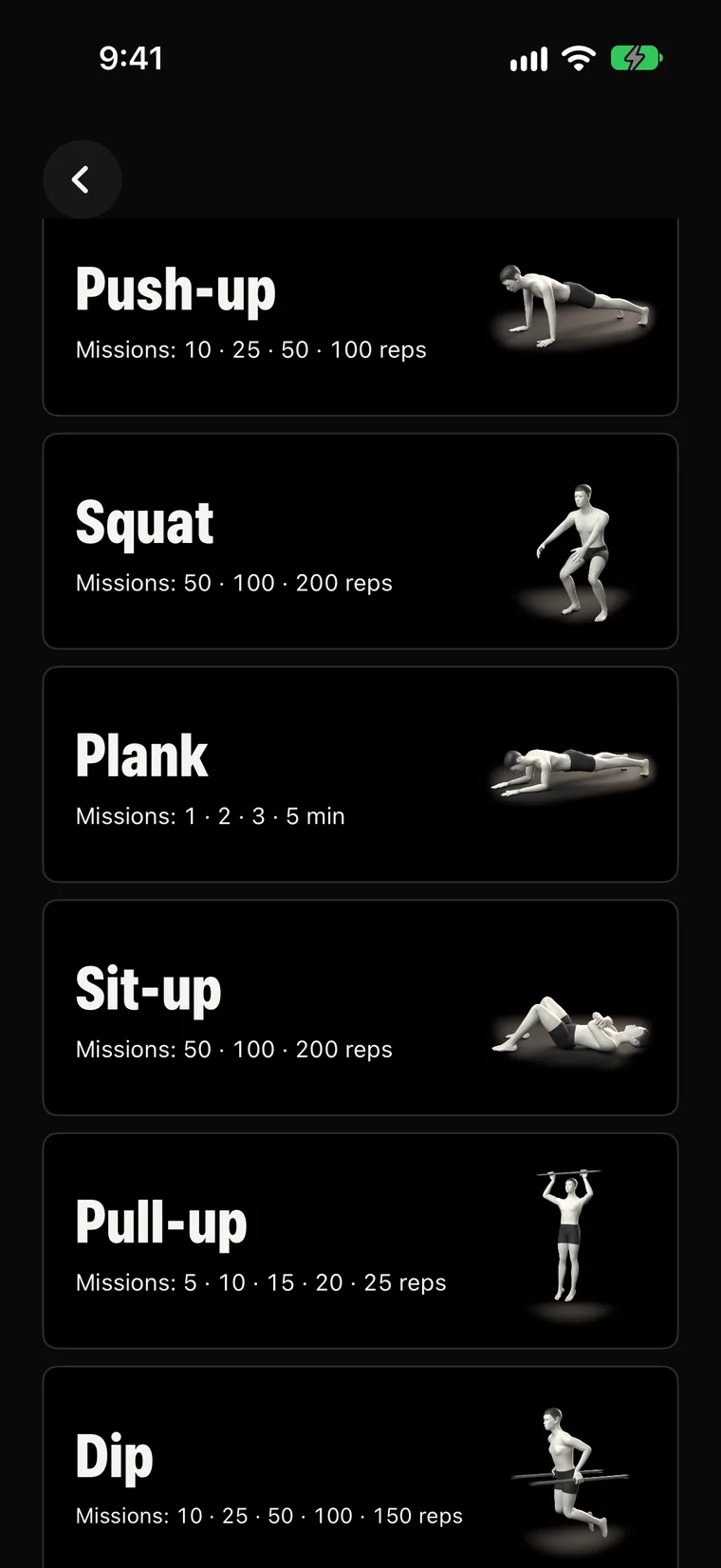
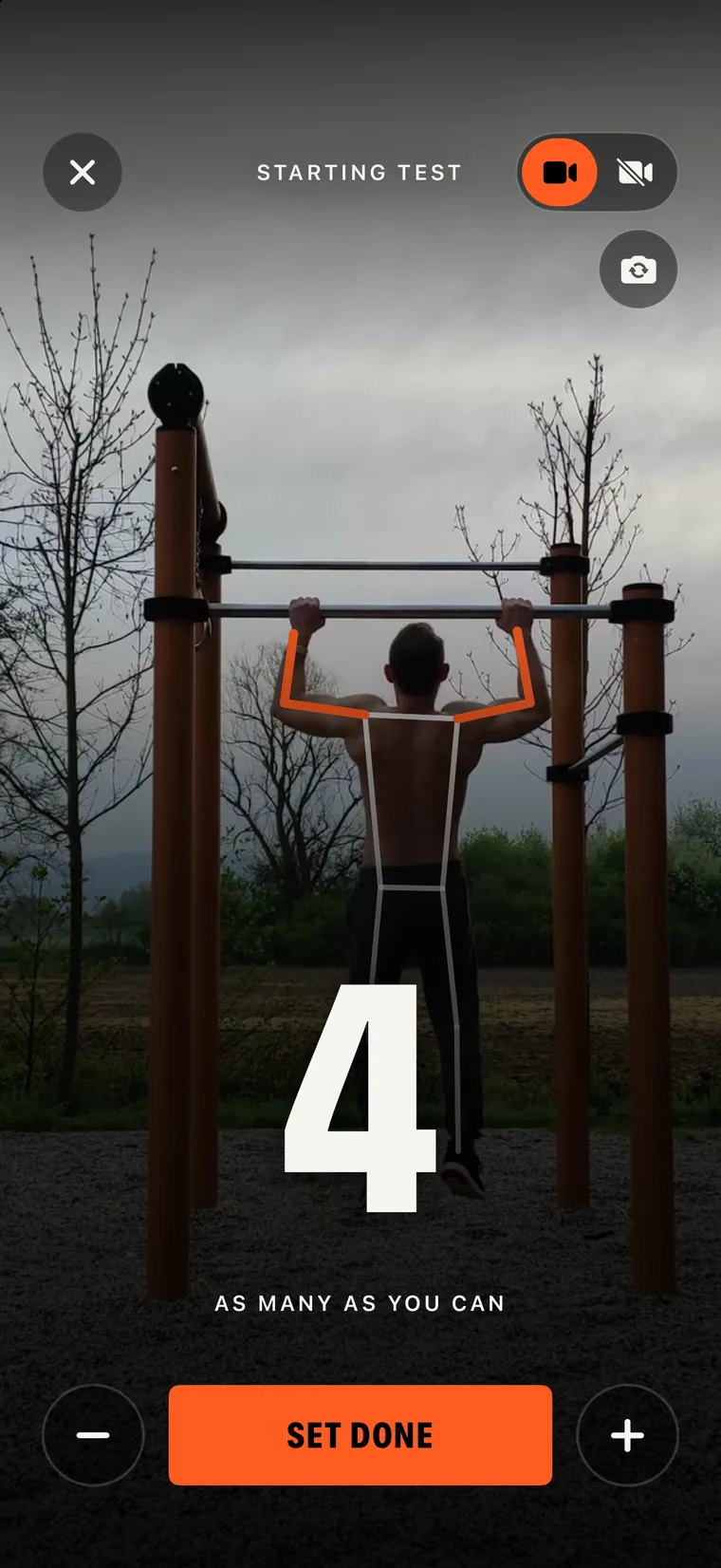
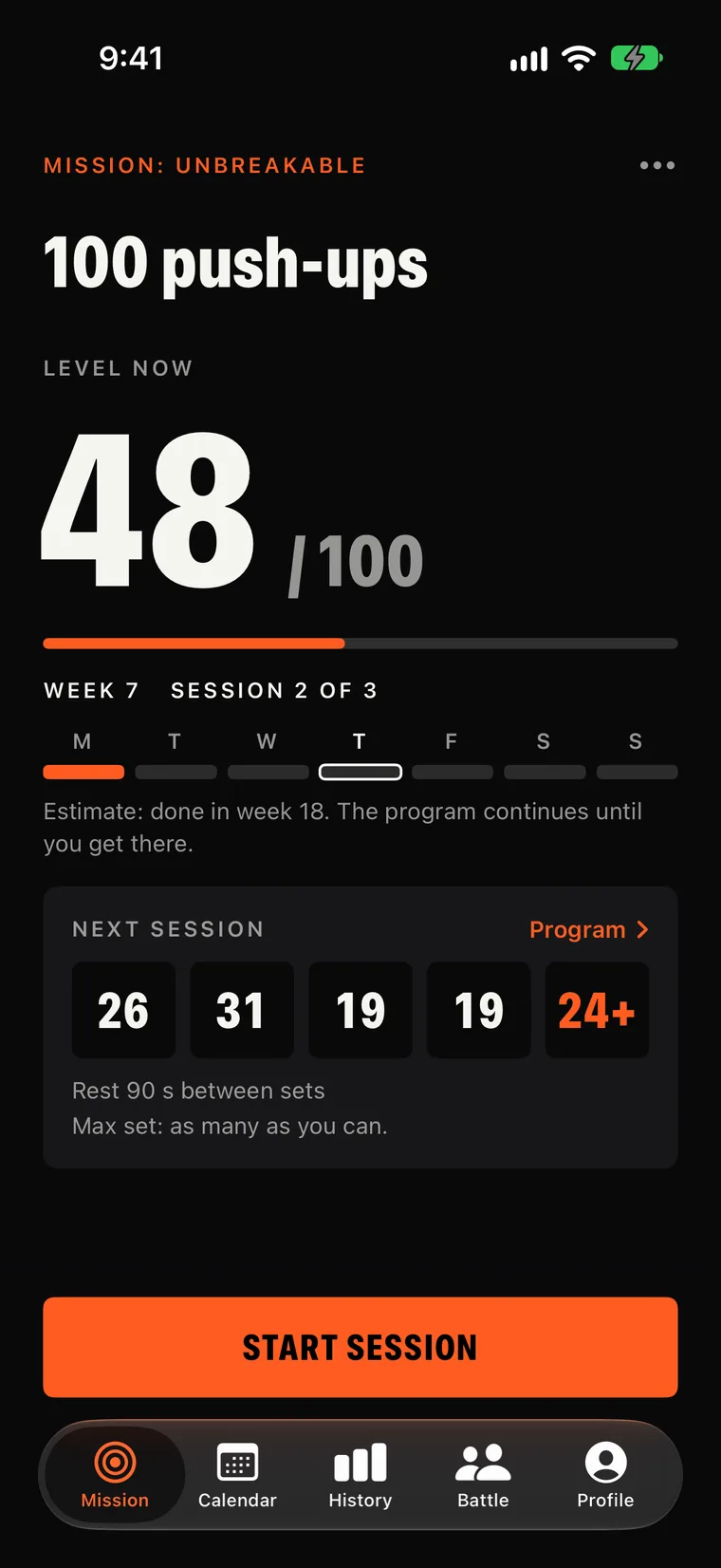
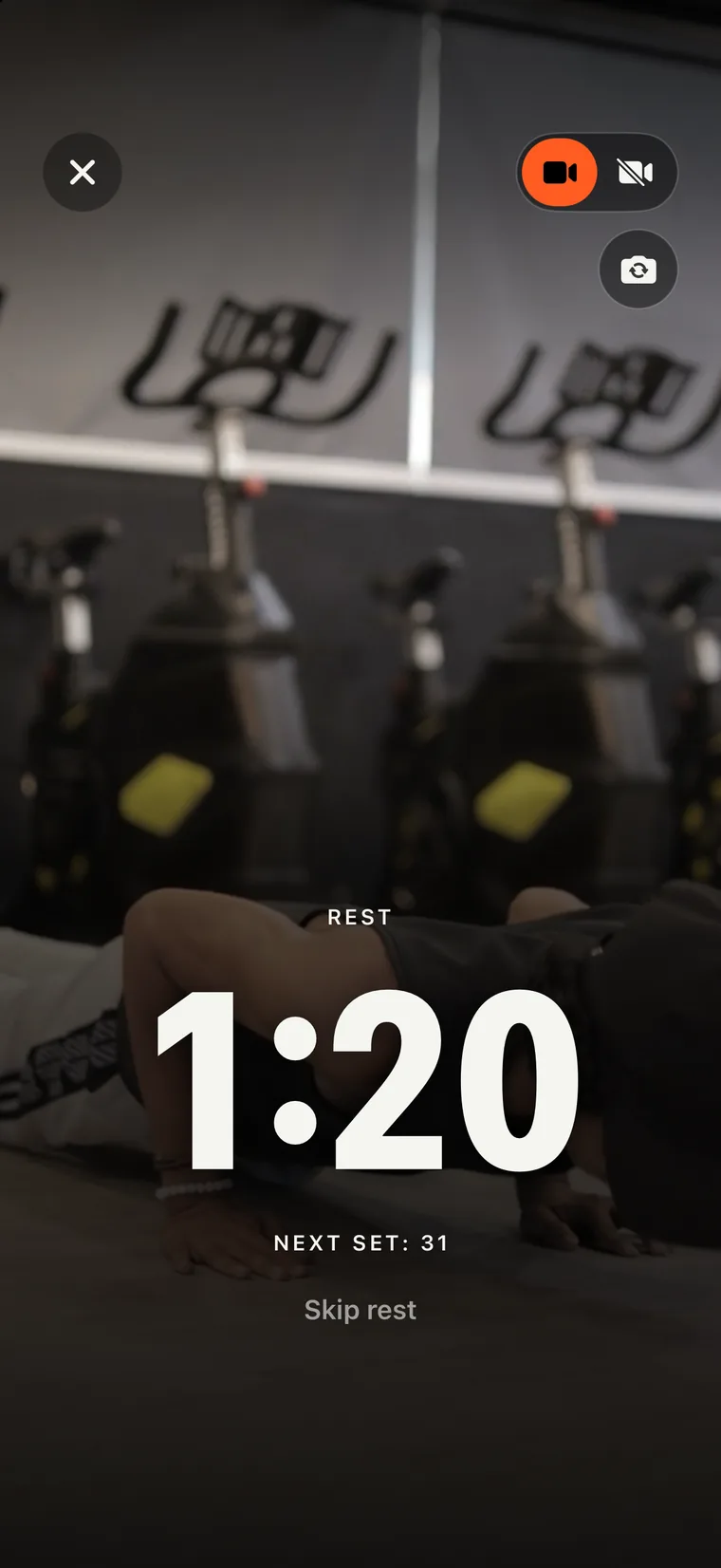
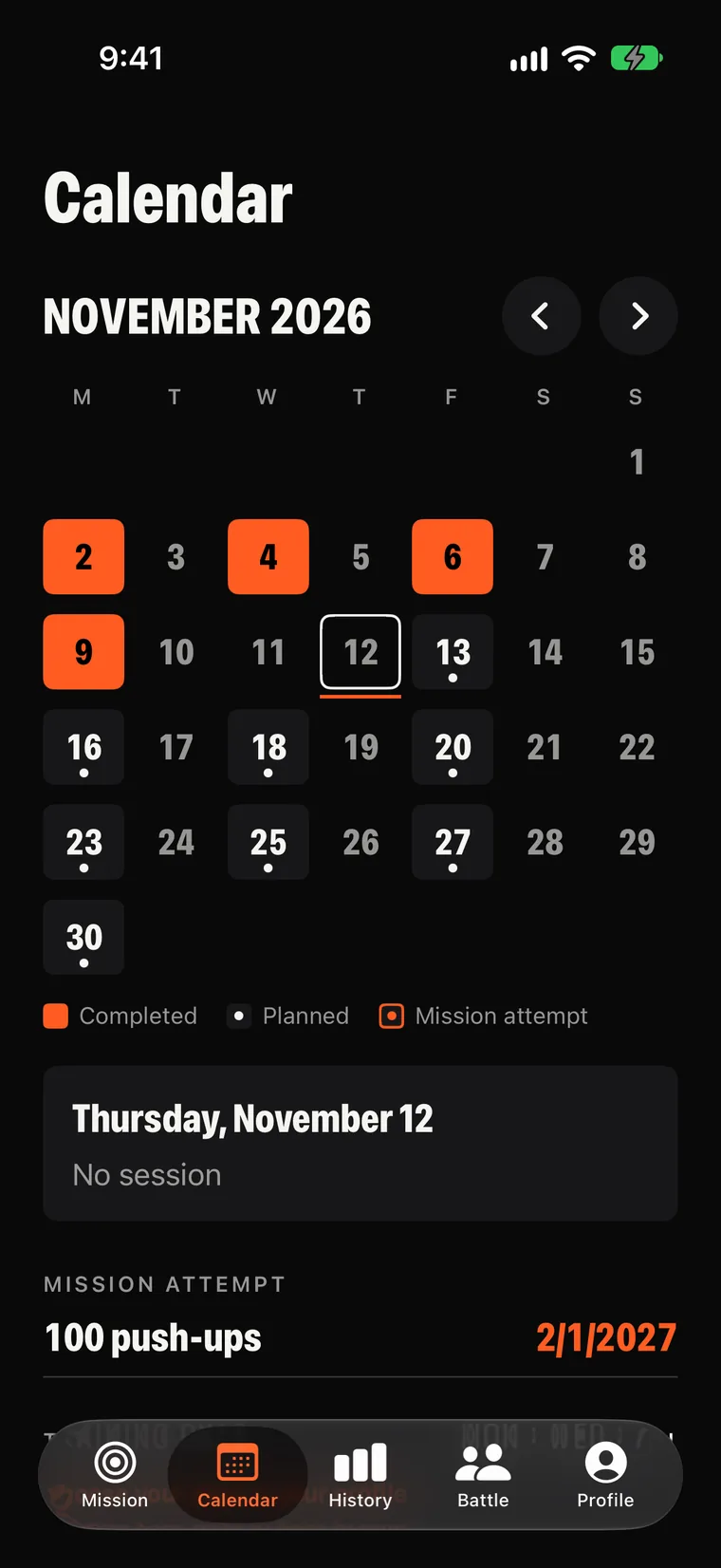
The screenshots are from the English version of the app, and some of them show a push-up mission.
It depends on your starting level and body weight, and research does not give one number for everyone. According to the Marine Corps’ Misty Posey, it does not take months and months. After the starting test, MISSION: Unbreakable shows an estimate of the week in which your goal is within reach, and the estimate gets more accurate with every test.
For a beginner, 2 to 3 times a week on alternate days. This matches the ACSM recommendation for beginner strength training and the UKK Institute’s recommendation of muscle-strengthening at least twice a week.
It is the lowering phase of the pull-up on its own. You step up or jump so that your chin is over the bar and lower yourself slowly, over 3 to 5 seconds, to straight arms. The muscles are less loaded when lowering than when pulling, so a negative often works before your first full pull-up. In experienced climbers, eccentric training increased maximum pull-up strength in five weeks (Vigouroux and Devise 2024). We did not find a similar study in beginners.
Yes. The rules for a full rep are the same whatever the grip: from a straight-arm hang, chin over the bar and back to straight arms. Keep the grip the same in tests so that the results can be compared. The MISSION: Unbreakable camera measures how far your shoulders rise relative to your own hang, so the width of your grip does not affect counting.
Dead hangs get your grip and shoulders used to the bar and are the starting position of every pull-up, but they do not train the pull. Do them alongside negatives and assisted pull-ups.
A band helps if you have no other help. According to Posey, however, bands and assistance machines do not train the pull-up movement as well as bodyweight negatives, jumping pull-ups and partner-assisted pull-ups.
No. The camera counts full pull-ups and bar dips. Negative pull-ups and bench dips are counted by hand: the app shows the target for each set, and you enter the reps you did.
Stop the movement that hurts and see a physiotherapist or a doctor. This guide and the app give general information about training, not medical advice.
The training information was checked against these sources on 29 November 2026. The app’s features were checked against the MISSION: Unbreakable source code and documentation.
How to test your push-up level, build a program and work up to 100 push-ups. With form, easier starts, a realistic timeline and the MISSION: Unbreakable app.
Camera countingHow the iPhone camera counts push-ups, squats, pull-ups, dips and sit-ups, where to place the phone and why a rep may not count. The MISSION: Unbreakable app as an example.
Spot electricity appWhat to check in a spot electricity app (15-minute prices, your own price, widgets, watch, what is free) and where Päivän Sähkö fits.
This guide is written by Kiltala Oy, which also builds websites for businesses in Lappeenranta and the rest of South Karelia, and remotely across Finland.
A website for your business, a review of your current site or an app idea. We will reply soon.