Training guide

100 push-ups: a program to get from where you are to 100

One hundred push-ups in a row is a well-known fitness challenge. You can work toward it from almost any starting level, but rarely in six weeks. In this guide you test your level, put together a program of sets, rest and tests, learn what counts as a full push-up and see how long reaching 100 realistically takes. At the end you see how the iPhone app MISSION: Unbreakable builds the program for you and counts your reps with the camera.

Written by Aleksi Kiltala, Kiltala Oy · Updated 29 November 2026

Short answer

Start with a max test: as many full push-ups as you can do in one go. Then train three times a week with a rest day in between. Do five sets per session: four well below your max and a last one as long as you can. Rest one to two minutes between sets. Retest every couple of weeks and make the program lighter if sessions fall short. If you cannot do five push-ups yet, start against a wall or a table, or on your knees. There is no researched timeline. The cautious plan in MISSION: Unbreakable estimates about 18 weeks from 20 push-ups to 100.

MISSION: UnbreakableiPhone · iPhone Duo
Step 1

Test your level with a max test

The program is built on how many full push-ups you can do in one go today. That is why the test is done carefully and the same way every time.

  1. Warm up.Walk for a while, circle your arms and do a few easy push-ups against a wall or on your knees. For the tests in its program, MISSION: Unbreakable gives you a short warm-up set first and then a three-minute rest.
  2. Decide the rules in advance.Decide what counts as a full rep and whether you may pause at the top with straight arms. Keep the same rules in every test, or the results cannot be compared.
  3. Do one set for as long as your form holds.Count only full reps. The set ends when you can no longer push back up to straight arms or your body no longer stays straight.
  4. Write down the result and the date.The result is the starting level of your program. Also note whether you did the push-ups on your toes or on your knees.
  5. Retest every couple of weeks.Your level changes as you train, so the numbers in the program have to be updated. The Hundred Pushups program, for example, has an initial test and a final test, and MISSION: Unbreakable also tests your level in weeks 2 and 4 of the six-week program.

This guide is general information, not medical advice. If you have a heart condition, high blood pressure, another illness or an injury, or pain in your shoulders, wrists or back, talk to a doctor before you start. Stop the set if something hurts.

Step 2

What a program toward 100 looks like

A good program adds volume gradually, leaves time to recover and checks your level with tests. These six things come up again and again in push-up programs and training guidelines.

Three sessions a week

The most common structure is three sessions a week with a rest day in between. The ACSM recommends 2–3 strength sessions a week for beginners and 3–4 for people who have trained for a while. The Finnish UKK Institute recommends muscle strength training at least twice a week.

Five sets, the last one to your max

The first four sets are well below your max, and the last one goes on as long as you can. For muscular endurance, the ACSM recommends light to moderate loads and sets of more than 15 reps. For many people a bodyweight push-up is exactly that kind of load.

One to two minutes of rest

For muscular endurance training the ACSM recommends rests of under 90 seconds between sets. In the MISSION: Unbreakable program the rest is 60 seconds in the first session of the week, 90 in the second and 120 in the third, and the longer the rest, the bigger the sets.

Test weeks

A test tells you whether your level has gone up. On a test day you warm up, rest well and do one max set. The sets for the following weeks are worked out from the new result.

Lighter when results drop

If two sessions in a row fall short, make the program lighter instead of forcing the same numbers again. Longer programs also have light weeks. No research was found on when light weeks should come, so they are practical rules.

Not every set to failure

A meta-analysis by Grgic and colleagues found that strength and muscle size grow even when sets are not taken to failure. It looked at strength and muscle size, not endurance. That is why in many programs only the last set is a max set and the others leave a few reps in reserve.

Example: the first two weeks from 20 push-ups

Below is the start of the program MISSION: Unbreakable calculates for a starting test of 20 and three sessions a week. The sets are shares of your level, so they grow as your level goes up. The number for the last set is the minimum, and after that you keep going as long as you can.

SessionRest between setsSets (reps)
Week 1, session 160 s10 · 12 · 7 · 7 · at least 9
Week 1, session 290 s12 · 14 · 9 · 9 · at least 11
Week 1, session 3120 s14 · 16 · 10 · 10 · at least 13
Week 2, session 160 s12 · 15 · 9 · 9 · at least 11
Week 2, session 290 s15 · 17 · 11 · 11 · at least 13
Week 2, session 3180 sMax test: warm-up of 4, then as many as you can

The structure (three sessions a week, five sets, a last max set and tests) comes from established programs and the ACSM recommendations. The shares of your level used for each set are the app’s own assumptions and are not copied from other programs.

Easier start

If you cannot do five push-ups yet

You can make a push-up easier by changing the angle. The more upright your body, the less of your weight is on your arms.

  1. Wall push-up.Stand a stride away from a wall with your hands at shoulder height and shoulder width apart. Bend your arms, bring your head toward the wall and push back. This is the easiest level in the NHS hospital exercise sheet.
  2. Against a table or bench.Do the push-up against a sturdy table, a kitchen counter or a bench. NASM advises lowering the height gradually and moving to the floor when you can do 12–15 reps with good form.
  3. Knee push-up.Your knees are on the floor and your body is straight from knees to head. Go as low as you can with control. When you can do 12–15 knee push-ups, try the floor.
  4. Floor push-up.When you move to the floor, redo the starting test and start the program from the new result. Your first goal can be 10 push-ups.

MISSION: Unbreakable offers knee push-ups if your starting test is under five. The knee push-up mission is 15 reps in a row, and after that you move on to regular push-ups. You can also start straight with the 10 push-up mission. Knee push-ups are counted by hand.

Form

What counts as a full push-up

One hundred push-ups is only a comparable result if every rep is done the same way. These are the common requirements.

  • Hands shoulder width apart.Your palms are on the floor about shoulder width apart, with your shoulders above your hands.
  • Body straight.Head, back, hips and legs are in one line. Brace your core. Your lower back must not sag and your hips must not rise.
  • Low enough.The ACE instructions have you lower yourself until your chest or chin touches the floor. MISSION: Unbreakable counts a rep when your upper arms get roughly level with the floor. A shallower rep is not a full rep.
  • Back up to straight arms.The rep ends when your arms are straight again. The next rep starts from the top position.
  • Elbows angled back.NASM advises keeping your elbows at about 45 degrees from your body instead of flaring them straight out to the sides.

Lower yourself under control and push up at an even pace. Keep your head in line with your spine and do not lift your gaze forward. If your wrists, shoulders or lower back hurt, stop the set.

Timeline

How long it takes to reach 100 push-ups

It depends on where you start, and there is no researched timeline.

The best-known program, Hundred Pushups, says on its site that some people reach 100 in six weeks and others need longer. No peer-reviewed study on how many weeks it takes for maximum push-ups to reach 100 was found for this guide. Small studies only show that push-up training builds strength. Four weeks of training three times a week improved strength and push-up test results in moderately trained men. In another study, eight weeks of push-up training twice a week increased strength and muscle size, but the muscular endurance test did not improve.

The table below is the MISSION: Unbreakable plan’s estimate of the week in which 100 push-ups is reached, with three sessions a week and every session going to plan. The app caps weekly growth cautiously: about 25 percent at low levels and 9 percent close to 100.

Starting testEstimate: 100 push-ups reached
5 push-upsin week 28
10 push-upsin week 22
20 push-upsin week 18
40 push-upsin week 12
60 push-upsin week 8
80 push-upsin week 6

Estimates calculated from the app’s plan on 29 November 2026. The growth cap is the app’s own assumption and has not been confirmed by research. Real progress can be faster or slower.

If you start below 40 push-ups, an intermediate goal often makes more sense than going straight for 100. In the MISSION: Unbreakable plan, a starting test of 9–20 reaches 25 push-ups and a starting test of 25–40 reaches 50 push-ups in six weeks. The steps on the way count too: in a US follow-up study of firefighters, men who could do more than 40 push-ups had fewer cardiovascular events over ten years than those who could do fewer than 10. The study showed an association, not cause and effect, and included only men.

Avoid these

Common mistakes

Programs most often stall because sets are done too shallow, too often or with different rules.

Reps that are too shallow

Half reps raise the count but not your level. Count only full reps, also when the set starts to feel heavy.

A max set every day

If you test yourself every day, there is no time left to recover. Keep the rest days and do a max test only on test days.

Moving up too fast

If the program adds reps faster than you can keep up, sessions fall short. Make it lighter or repeat the week instead of skipping ahead.

Sagging back or rising hips

When your core gets tired, your hips drop or rise. That is when the set is over, even if your arms still have something left.

Tests with different rules

If the depth or the pauses change from one test to the next, you cannot see whether your level has really gone up.

Ignoring pain

Tired muscles are part of training, joint pain is not. Stop if your wrist, shoulder or back hurts, and see a doctor or physiotherapist if needed.

The app

How MISSION: Unbreakable does it

MISSION: Unbreakable is an iPhone app that builds the program from your starting test and counts the reps with the phone’s camera. It was released on the App Store on 28 November 2026.

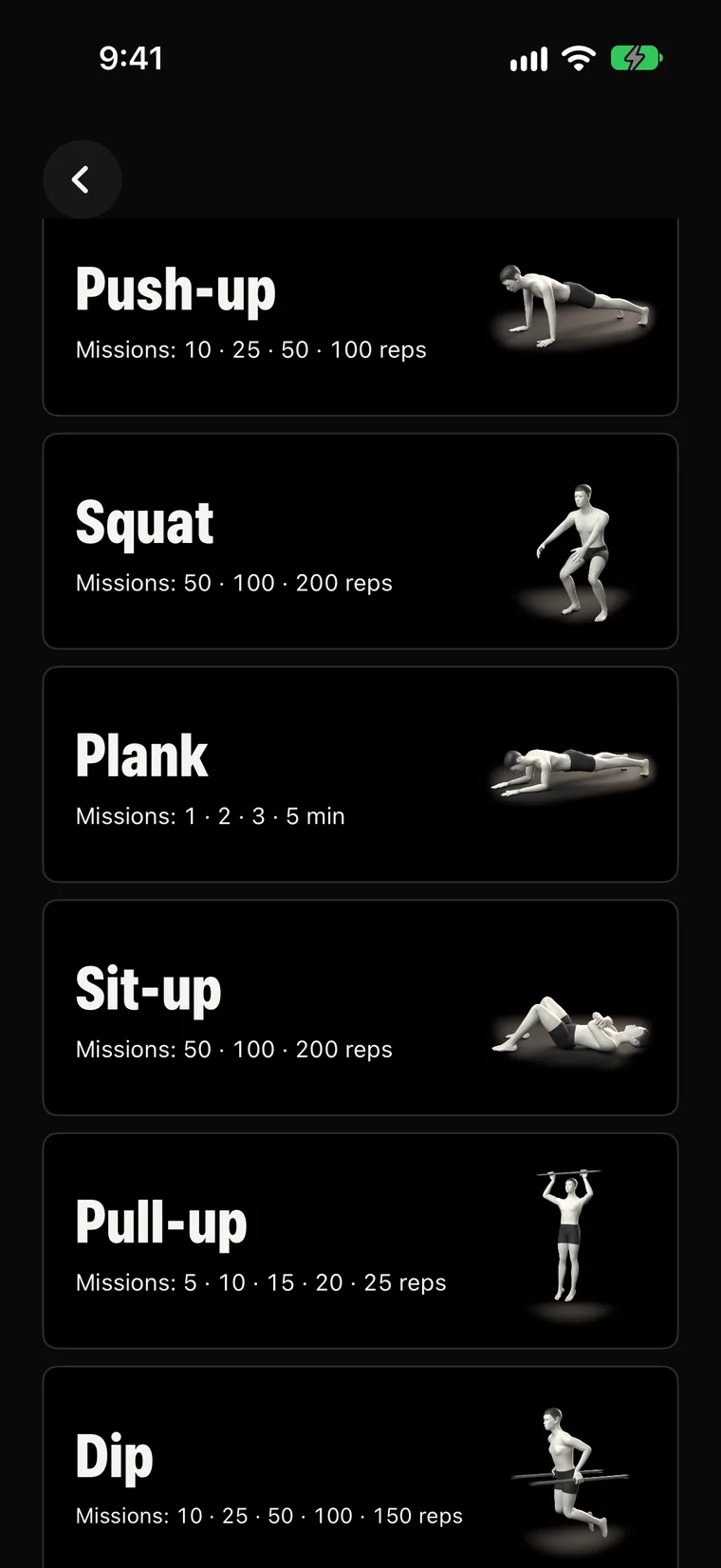
List of disciplines: the push-up missions are 10, 25, 50 and 100 reps
Disciplines and missions
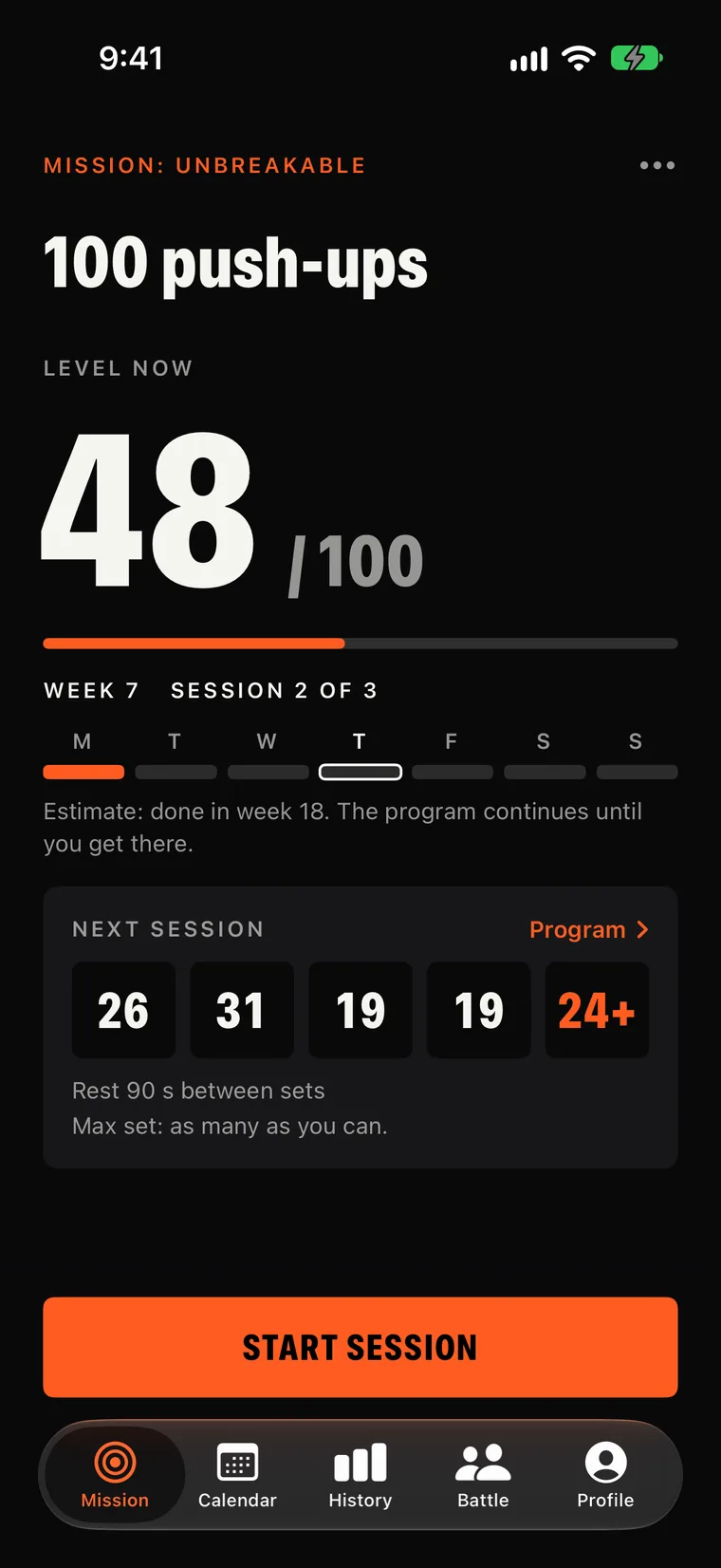
The 100 push-up mission: level 48/100, week 7, estimated finish in week 18 and the sets of the next session
Mission status
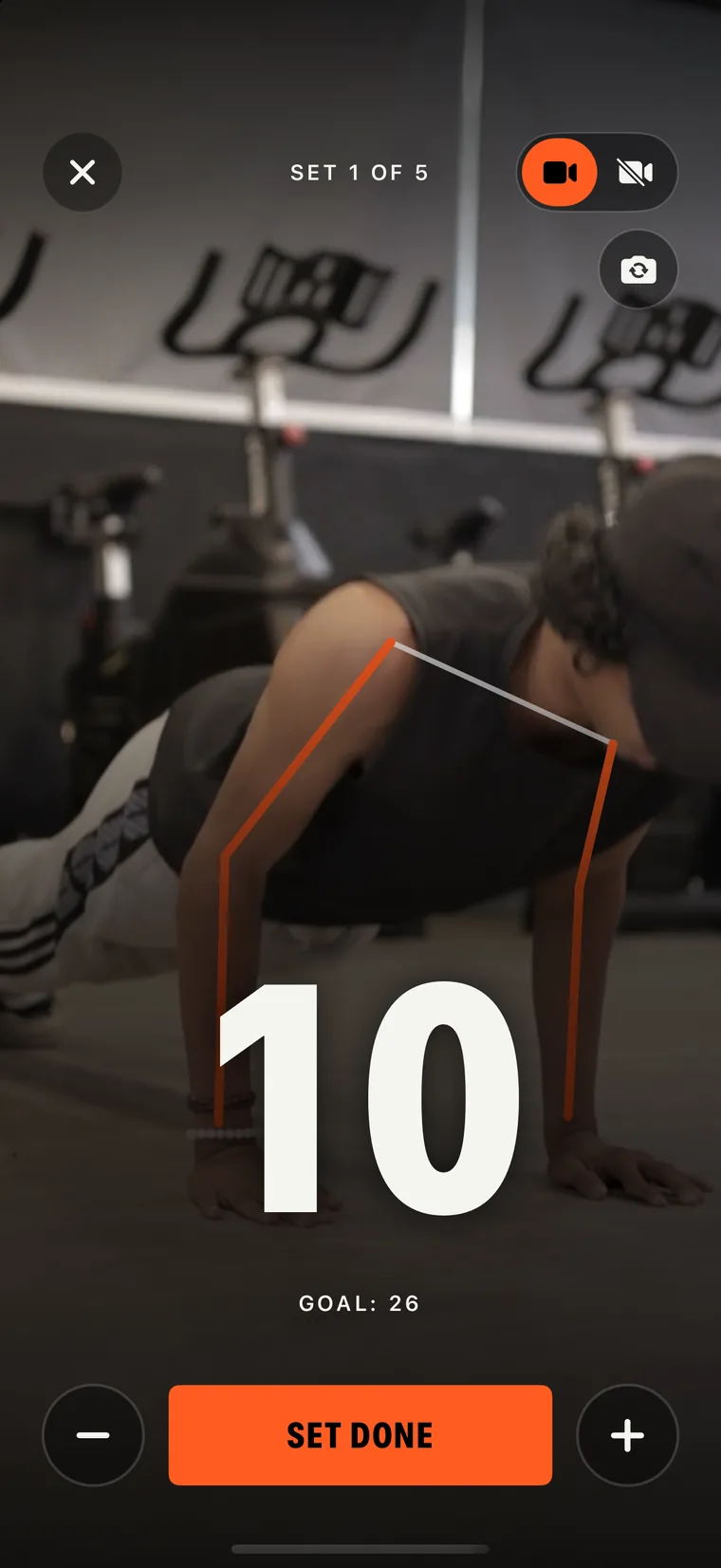
The camera counting push-ups: set 1 of 5, rep 10, goal 26
Camera counting
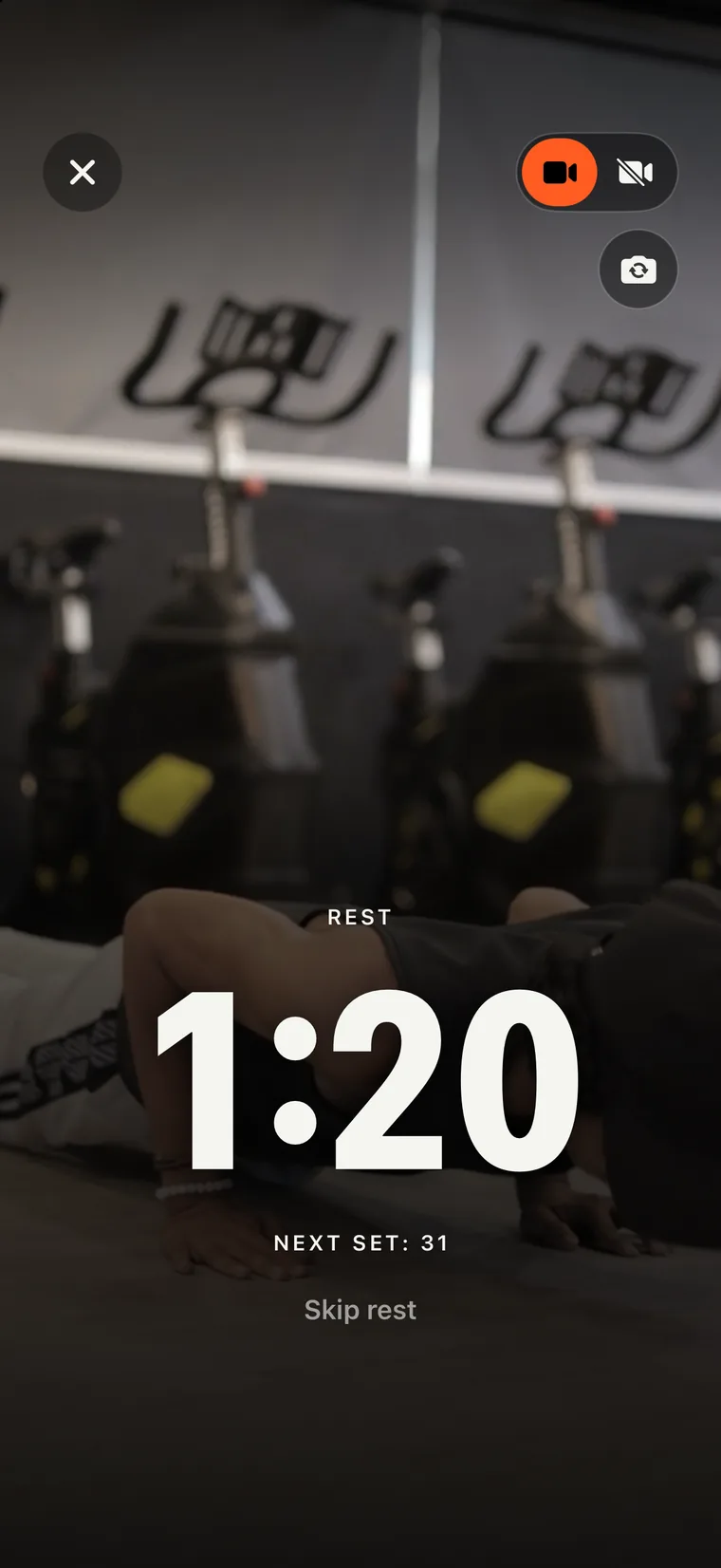
Rest timer: 1:20 left, next set 31 reps
Rest
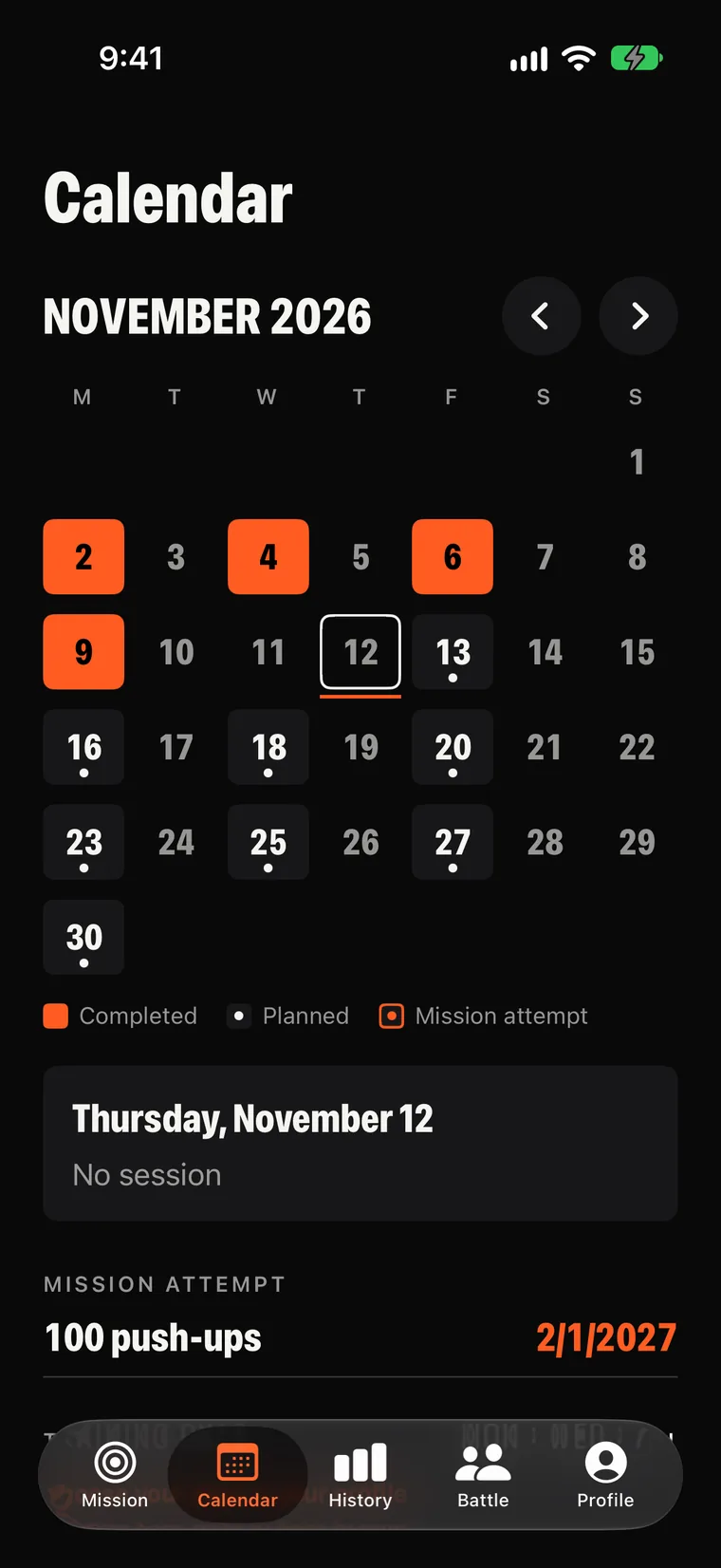
Calendar: completed and planned sessions and the date of the 100 push-up mission attempt
Calendar

Starting test

Pick the discipline and do the starting test: as many push-ups as you can in one go. Based on the result, the app suggests the 10, 25, 50 or 100 push-up mission, but you can choose any of them. The estimated finishing week is always shown.

A program from your results

In the free version the program is six weeks. With Pro it can also be 8, 10 or 12 weeks. You train 2, 3 or 4 times a week. Tests along the way check your level, and the program gets lighter or harder with your results.

The camera counts only full reps

Lean your iPhone against something on the floor. The camera counts push-ups from the side, the front or at an angle, as long as your arms and shoulders are in the picture. A rep counts when your upper arms get roughly level with the floor. A rep that is too shallow gets the hint Go lower.

A voice counts

A voice counts your reps, the last seconds of each rest and the start and end of every set, so you never need to look at the screen mid-set. You can switch the camera off, count yourself and let a 3D figure show the movement.

When results stall

One session that falls short keeps your level where it is; two in a row make the program 10 percent lighter. If two sessions in a week fall short, the week is repeated. The last week is light before the mission attempt. After a break of two weeks you start with a max test.

Missions 10, 25, 50 and 100

Push-ups have four missions, plus a 15 knee push-up mission. If the mission attempt does not succeed, the program goes on and the attempt is repeated when your level is there. The extra weeks are free.

For free you get every discipline and every mission, one discipline at a time, with the six-week program, camera counting, the calendar, history, achievements and Battle, where you compare progress with friends. Pro adds several disciplines at the same time, programs of up to 12 weeks, trend and records, technique feedback on depth and tempo, shorter or longer rests and your sessions in the iPhone’s Calendar. Pro is available as a yearly subscription or a one-time purchase. Prices are not given here, because the app shows the App Store price.

The app has no account, no ads and no tracking. The camera image is processed on the phone as it happens, and nothing is recorded or sent. Your training stays on your iPhone, and only what you choose to share in Battle leaves it. More in the privacy policy. MISSION: Unbreakable is available on the App Store for iPhone (iOS 17 or later) and iPhone Duo.

The app is available in English, Finnish, Russian, Italian, Spanish, French and German. The screenshots are from the English version. The app’s program is a training program and does not replace advice from a doctor or physiotherapist.

FAQ

Frequently asked questions

How fast can you get to 100 push-ups?

There is no researched timeline, and it depends on where you start. The cautious plan in MISSION: Unbreakable estimates that from 60 push-ups you reach 100 in about week 8, from 20 push-ups in about week 18 and from 10 push-ups in about week 22, with three sessions a week.

Do I need to do push-ups every day?

No. Most programs are built on three sessions a week with a rest day in between. The ACSM recommends 2–3 strength sessions a week for beginners and 3–4 for people who have trained for a while. The rest days give you time to recover for the next session.

Can I start with knee push-ups?

Yes. If you cannot do five regular push-ups yet, start against a wall or a table, or on your knees, and move to the floor when you can do 12–15 reps with good form. MISSION: Unbreakable offers knee push-ups when your starting test is under five.

What counts as a full push-up?

Your body is straight from head to heels, you go down at least until your upper arms are level with the floor, and you push back up to straight arms. Half reps do not count. The MISSION: Unbreakable camera counts a rep only when your upper arms get roughly level with the floor.

What if I stop making progress?

Repeat the week or make the sets about one tenth lighter. Make sure you keep your rest days and do your tests with the same rules every time. If you stay stuck for a long time, do a new max test and build the program from that result.

How long should I rest between sets?

For muscular endurance training the ACSM recommends rests of under 90 seconds. MISSION: Unbreakable uses 60, 90 and 120 second rests in the different sessions of the week and three minutes before the max set of a test. With Pro you can make the rests 30 seconds shorter or longer.

Does MISSION: Unbreakable record video of me?

No. The camera image is processed on the phone as it happens, and nothing is recorded or sent. The app has no account, no ads and no tracking. You can also switch the camera off and count the reps yourself.

Is MISSION: Unbreakable free?

The free version includes every discipline and mission, one discipline at a time, the six-week program, camera counting, the calendar, history, achievements and Battle. Pro adds things such as several disciplines at the same time and programs of up to 12 weeks. Pro is available as a yearly subscription or a one-time purchase, and the app shows the price from the App Store.

Contact

Tell us what you need.

A website for your business, a review of your current site or an app idea. We will reply soon.

Your message comes straight to us.